Call us: 905-922-1214


What Can Trigger an MTO Facility Audit?
According to Ontario’s Commercial Vehicle Operator safety guidance, common reasons for a facility audit include:
- Increasing CVOR violation rates or concerning on-road events.
- A failed facility audit within the previous five years without a later passing audit.
- MTO verifying commitments made to the Deputy Registrar.
- Complaints about unsafe drivers, vehicles or company operations.
- A voluntary audit requested by the carrier to support its Carrier Safety Rating.
MTO can also audit a carrier when circumstances justify further review.
That is why waiting for a formal audit notice is poor compliance management.
Why an MTO Facility Audit Matters to Your CVOR
A facility audit examines more than your CVOR percentage.
MTO may review whether your company has effective controls for:
- Driver qualification.
- Hours of service.
- ELD monitoring.
- Vehicle maintenance.
- Daily inspections and defects.
- Collisions.
- Convictions.
- Training.
- Corrective action.
The key issue is due diligence.
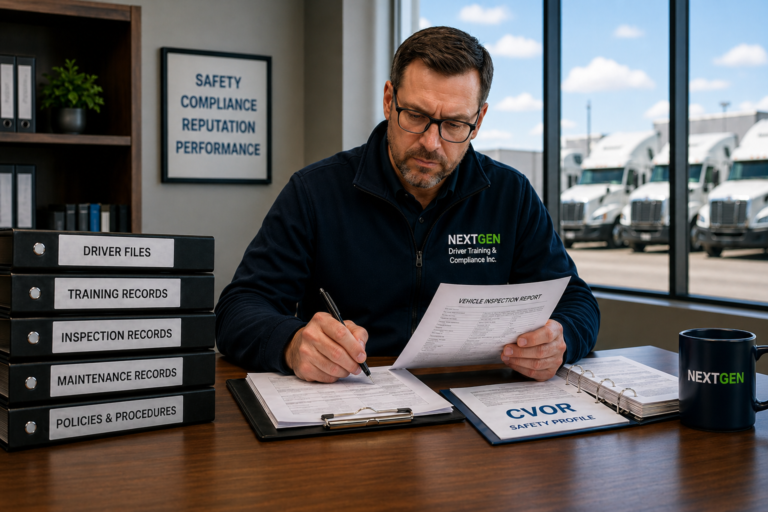
Having a policy does not prove compliance. Your company needs records showing that management monitors the policy, identifies problems and takes corrective action.
What MTO Looks for During a Facility Audit
MTO facility audits generally examine three major areas:
Vehicle Maintenance
Can you prove that vehicles are inspected, maintained, repaired and released safely?
Hours of Service
Can you demonstrate that driver hours are monitored and violations are identified and corrected?
Driver Qualifications, Records and Reporting
Can you produce current driver records, abstracts, licence information, training documentation, collision records and other required files?
A carrier can have excellent policies and still experience audit problems if the supporting records are missing.
Warning Signs Your Fleet Should Not Ignore
Watch for patterns such as:
- Multiple roadside inspections.
- Out-of-service defects.
- Speeding or other driver convictions.
- Reportable collisions.
- Repeated HOS violations.
- Maintenance deficiencies.
- Drivers failing to report convictions or defects.
- Previous MTO warning letters or interventions.
One event may not trigger an MTO facility audit.
Several events pointing to the same control failure can create a much larger concern.
What Your Fleet Should Do Today
- Pull your current CVOR record.
- Review collisions, convictions and inspections.
- Investigate every out-of-service event.
- Audit driver qualification files.
- Review HOS and ELD compliance.
- Compare maintenance schedules with completed repairs.
- Confirm defects have been properly closed.
- Document driver training and corrective action.
- Assign responsibility for outstanding deficiencies.
- Record management follow-up.
The objective is simple:
If MTO asks why something happened, you should be able to show what management did about it.
Common MTO Facility Audit Mistakes
Ontario carriers frequently create unnecessary audit exposure by:
- Reviewing an incident but failing to document the review.
- Keeping ELD records without actually auditing them.
- Repairing a vehicle defect without closing the paperwork loop.
- Having policies drivers were never trained on.
- Waiting until MTO requests records before checking whether files are complete.
These are management-control failures, even when they do not individually create CVOR points.
Elevate Your Digital Future
Driving global business growth through innovative solutions and unparalleled expertise.
Get Started TodayNEXTGEN Compliance View
When conducting a mock audit, I trace CVOR events back into the carrier’s internal system.
For example:
Roadside brake defect → DVIR → maintenance history → repair → driver reporting → management review.
Or:
HOS violation → ELD record → supervisor review → driver coaching → corrective action → follow-up.
The question is not simply, “Do you have the document?”
The better question is:
“Can you prove your compliance system is working?”
For information on CVOR compliance audits and file reviews, visit NEXTGEN Driver Training & Compliance – CVOR Compliance Audits & File Reviews.
Quick FAQ
Does one collision trigger an MTO facility audit?
No. One collision does not automatically trigger an audit, but it can affect CVOR performance and contribute to increased Ministry attention.
Does a warning letter mean an audit is coming?
Not automatically. It does mean MTO has identified performance concerns that should be addressed immediately.
Can MTO audit a carrier with a Satisfactory-Unaudited rating?
Yes. A Satisfactory-Unaudited rating does not prevent MTO from conducting a facility audit.
What records are most important?
Driver files, HOS records, ELD reports, DVIRs, maintenance records, collision files, training records and documented corrective action are all important.
Do Not Wait for the Audit Letter
Audit your records now. Identify the gap. Correct it. Document the corrective action. Then verify that the control continues to work.
A carrier should find its own compliance weaknesses before MTO does.