Call us: 905-922-1214

For a lot of small Ontario fleets, the 160 km radius exemption gets talked about like a free pass.
It is not.
That misunderstanding is where trouble starts. Owners hear “local radius,” “no logbook,” or “ELD exemption,” and assume they are outside the reach of Hours of Service rules. In reality, Ontario’s Hours of Service rules still apply to many regulated vehicles over 4,500 kg, and the 160 km exemption only removes the daily log requirement for that day if specific conditions are met. The operator still has recordkeeping duties, still has oversight obligations, and still carries compliance risk if those records are weak or missing.
For landscapers, utility contractors, electricians, and other local trades, that matters. These are exactly the kinds of operations that run short-haul, seasonal, multi-stop work and often assume local movement means low enforcement risk. It does not.
What Is the 160 KM Radius Exemption?
Under Ontario’s Hours of Service regulation, a driver does not have to keep a daily log for a day if the driver:
- drives solely within a 160 km radius of the location where the day started, and
- returns at the end of the day to that same location.
That is the core exemption. It is narrow, and it is conditional.
It does not mean the driver is exempt from all Hours of Service rules. Ontario still requires daily off-duty time, cycle compliance, and operator monitoring. The MTO truck handbook also makes clear that if the daily log exemption applies, the operator must still keep a record for that day showing the driver’s details, cycle, duty status times, and totals.
For small fleet management, this is the key point: local does not mean exempt from compliance.
Is the 160 KM Rule Based on Driving Distance or a Map Radius?
This is one of the biggest misunderstandings in the field.
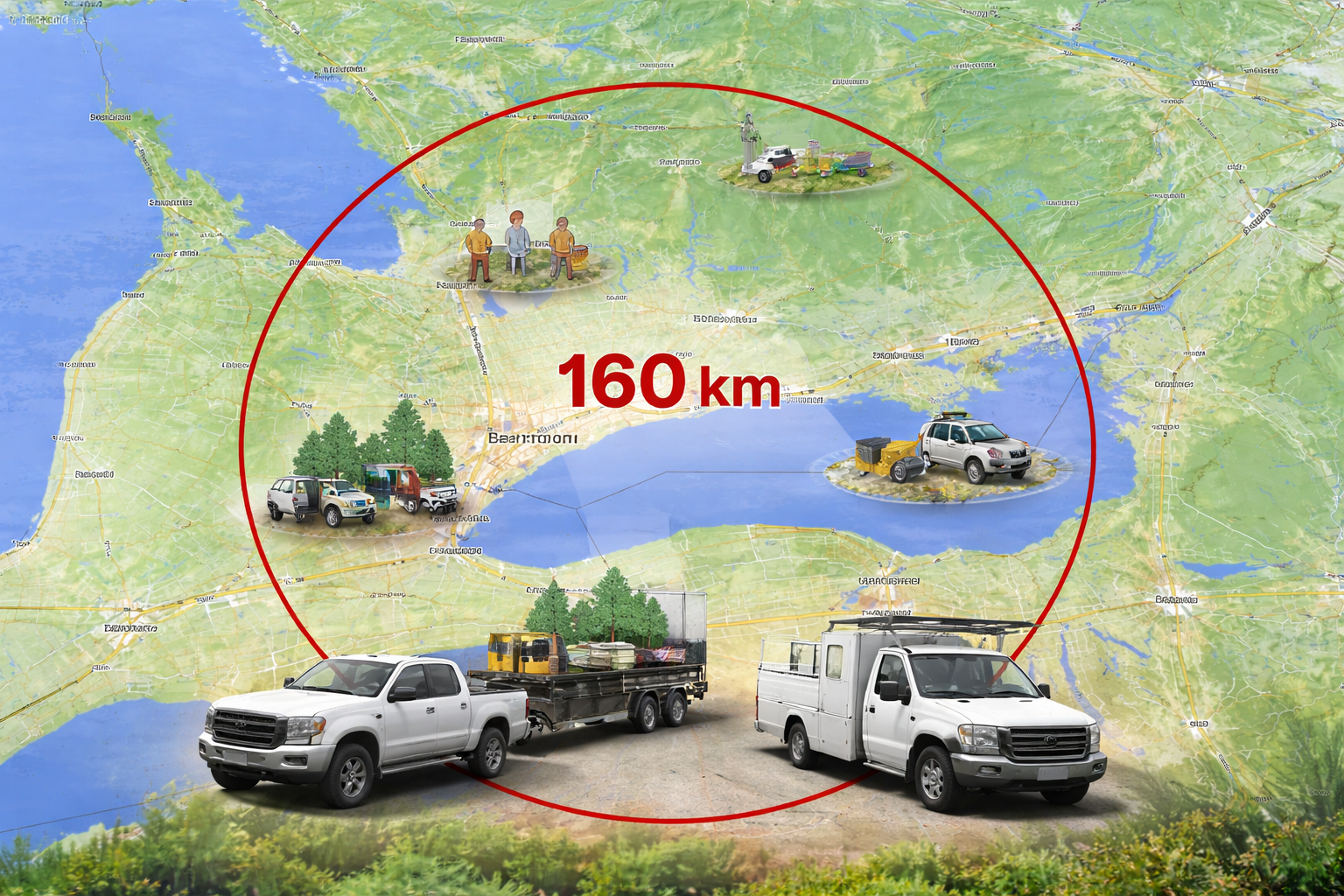
The rule is based on a radius from the location where the driver starts the day, not the total odometer distance traveled during the day. Ontario’s regulation uses the wording “within a radius of 160 kilometres of the location at which the driver starts the day.”
That means a driver can make several stops, zig-zag across a region, and still comply, provided the operation stays within that 160 km radius and the driver returns to the same start location at day’s end. But if the operation pushes beyond that radius, the exemption is gone for that day.
For local contractors, this is where “project creep” causes problems. A job that looks local on paper can drift outside the radius through detours, added service calls, or a supervisor sending the driver to one extra site.
Do I Need a Logbook if I Stay Within 160km?
Not necessarily. But this is where people get sloppy.
If the driver stays within the 160 km radius and returns to the same starting location at the end of the day, Ontario allows an exception to the daily log requirement.
That does not mean no paperwork.
Ontario requires the operator to keep a record for that day showing:
- the date
- the driver’s name
- the location where the driver started and ended the day
- the cycle the driver is following
- the hour each duty status started and ended
- total hours spent in each duty status
- the hours of on-duty and off-duty time accumulated during the prior 14 days for exempt days where no daily log was required.
That last point matters. The “no logbook” crowd often misses the 14-day recordkeeping piece entirely.
The Paperless Myth: You Still Need Records
This is where many small fleets get burned.
They think the exemption means:
- no ELD
- no daily log
- no hours records
- no problem
That is wrong.
Ontario’s rule is explicit: when the daily log exemption applies, the operator shall keep a record for the day. The MTO handbook repeats that requirement and identifies the core items that must still be documented.
So while the driver may not need a formal graph-grid logbook that day, the fleet still needs defensible time records. In practical terms, that means the business should be able to show:
- start time
- end time
- on-duty and off-duty periods
- total hours
- location where the day started and ended
- cycle being followed
- prior exempt-day hours information as required
This is the part that matters for commercial vehicle compliance in Ontario. If enforcement asks for records and your answer is “we’re under 160 km, so we do not keep them,” that is not a defence. It is evidence of weak controls.
What Vehicles Are Exempt from ELD in Canada?
Transport Canada’s guidance says that if you operate within 160 km of the home terminal and return there each day, you are not required to complete a Record of Duty Status for that day and therefore do not require an ELD for that operation. Transport Canada also lists other exemptions, including certain pre-2000 model year vehicles, certain short-term rentals, and some permit or exemption-based situations.
But small fleets need to be careful here.
The real question is not, “Do I want an ELD?” The real question is, “Was this driver actually exempt from RODS today?” If the answer is no because the driver left the radius, did not return to the same starting point, or otherwise fell outside the exemption conditions, the compliance requirement changes.
That is why ELD exemptions for small fleets are dangerous when treated casually. The exemption is operationally conditional, not a blanket privilege.
How do I track hours for the 160km radius exemption?
You track them the same way a serious business tracks anything that may need to be defended later: accurately, consistently, and in a form you can retrieve quickly.
For most small fleets, acceptable practical systems include:
- daily paper timesheets
- supervisor dispatch sheets
- payroll-based start and end time tracking
- mobile workforce apps
- digital field service time records tied to driver and vehicle
What matters is not whether the record is fancy. What matters is whether it captures the required information and can withstand scrutiny. Ontario requires the operator to keep a daily record when the exemption applies, and operators are also responsible for monitoring driver compliance.
If your crews start from the yard at 6:00 a.m., take a truck and trailer to multiple jobs, and return at 5:30 p.m., your system should clearly show that. Guesswork, handwritten fragments, and payroll summaries with no duty-status detail are weak.
Where Small Fleets Get Burned
Landscapers
This sector is full of exposure.
Many landscaping companies operate pickups, trailers, dumps, cube vans, or straight trucks that cross the regulated threshold. Ontario’s commercial vehicle safety framework applies to trucks with a gross or registered gross weight over 4,500 kilograms.
Common problems include:
- seasonal drivers with little understanding of Hours of Service
- no structured time-record system
- confusion about whether pickup-and-trailer combinations are regulated
- weak daily inspection and defect reporting habits
- assuming “local” means “non-commercial” for compliance purposes
That is why CVOR requirements for landscapers are often misunderstood. The business may think it is just doing local property work, while enforcement sees a regulated fleet with drivers, units, and records that must be managed properly.
Utility and Contractor Fleets
Utility subcontractors and trade contractors often run into a different problem: operational drift.
The day starts local. Then a site changes. Then another call comes in. Then the crew gets sent farther out. That is how a fleet that “never leaves the area” ends up outside the local radius conditions.
This is where the 160 km exemption becomes a trap. The operation was planned as exempt, but the actual day no longer fits the exemption.
What Happens if a Driver Goes Beyond 160 KM for One Day?
That one day matters.
If the driver goes outside the 160 km radius, the exemption conditions are no longer met for that day. Transport Canada’s ELD handout states plainly that if you drive outside the 160 km at any time, you will require an ELD where the federal ELD rules apply. Ontario’s regulation also makes clear that the daily log exception only exists when the driver operates solely within that radius and returns to the same starting location.
Ontario also requires records of the driver’s on-duty and off-duty time accumulated during the 14 days immediately before the start of the exempt day for which no daily log was required. That matters because once the operation changes, you need continuity in your records.
This is why owner-operators and dispatchers need a procedure for “radius break” days. Hoping no one notices is not a compliance strategy.
Common Misconceptions About the 160 KM Radius Exemption
“If I stay local, I do not need Hours of Service records.”
False. You may be exempt from the daily log, but the operator still must keep required records.
“If I am exempt from ELD, I am exempt from everything.”
False. ELD exemption and full compliance exemption are not the same thing.
“A pickup and trailer is not really a regulated fleet.”
False. Depending on weight and operation, many pickup-trailer combinations fall into the regulated space in Ontario.
“If I only go outside 160 km once, it does not matter.”
False. One non-exempt day is still a non-exempt day.
160 KM Exemption vs. Full Logbook / ELD Operation
| Requirement | 160 km exemption day | Non-exempt day |
|---|---|---|
| Daily log | Not required if conditions are met | Required |
| ELD | Generally not required if no RODS required | Required where applicable under federal rules |
| Operator time records | Required | Required |
| Return to start location | Must return to same start location | Not a condition of full-log operation |
| 14-day continuity | Still matters | Still matters |
The point is simple: the exemption reduces one format of paperwork. It does not remove the need for disciplined oversight.
Three Things You Can Do Today to Avoid MTO Trouble
1. Verify which vehicles and combinations are actually regulated
Do not guess. Review registered gross weight, actual operating weight, and how each unit is used.
2. Audit your time-record system
If your local crews are operating under the exemption, make sure your records capture the exact fields Ontario requires.
3. Build a written procedure for days that break the radius
Your supervisors need to know what happens when a “local” job becomes a non-exempt day.
FAQ
Is the 160 km radius exemption federal or provincial?
It depends on the operation, but Ontario has its own Hours of Service rule under O. Reg. 555/06, and Transport Canada also provides federal ELD guidance.
Do I need a logbook if I stay within 160 km?
Not if the Ontario exemption conditions are met, but the operator must still keep required daily records.
Is the 160 km measured by road distance?
No. Ontario’s wording refers to a radius from the location where the day starts.
Do local landscapers need CVOR-related compliance controls?
Yes, if they operate regulated vehicles. Local work does not remove compliance obligations.
What is the biggest mistake small fleets make?
Treating the exemption like an escape from oversight instead of a narrower recordkeeping rule.
Final Word
The 160 km radius exemption Canada operators talk about is not a shortcut around compliance. It is a limited exception to the daily log requirement under specific conditions. Small fleets still need accurate time records, disciplined supervision, and a plan for days when the work no longer fits the exemption.
If your business is unsure whether its current process would hold up under scrutiny, that is the issue to fix now, not after a roadside stop or audit request.