Call us: 905-922-1214

How Serious Fleets Build Systems That Hold Up Under Scrutiny
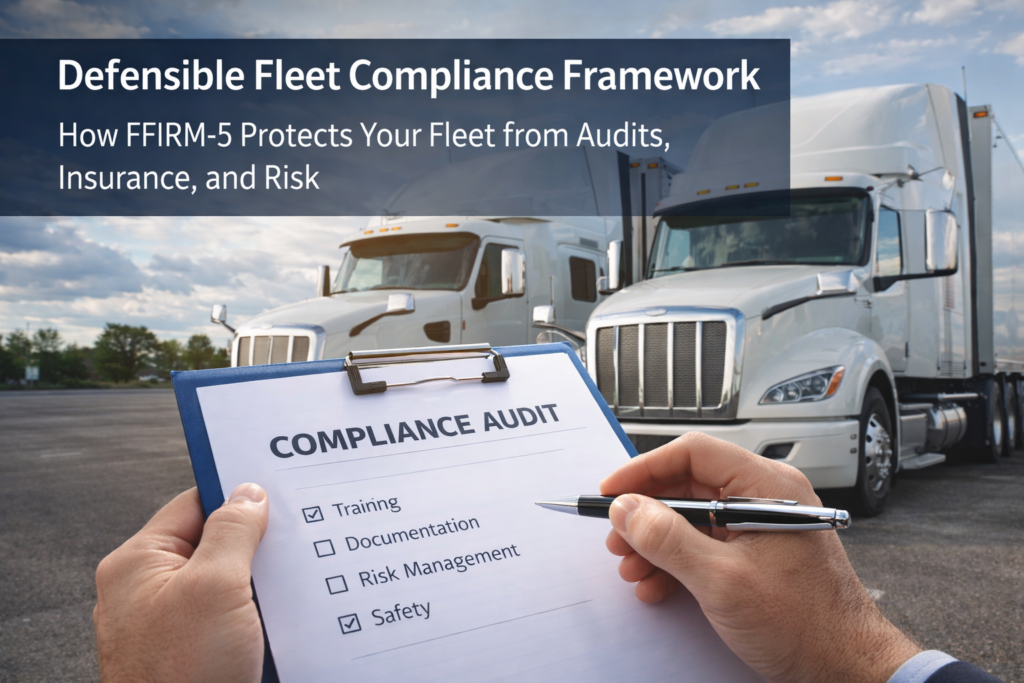
The defensible fleet compliance framework (FIRM-5) is a structured operating model designed to help regulated fleets build audit-ready systems, reduce operational risk, and demonstrate defensible compliance across leadership, training, execution, documentation, and risk intelligence.
Most Fleets Believe They’re Compliant — Until Something Tests the System
Audits, inspections, insurance reviews, and collisions don’t evaluate intentions.
They evaluate whether an operation has defensible systems, consistent execution, and documented accountability.
Many fleets operate with informal practices:
- Policies exist, but enforcement is inconsistent
- Training happens, but competency is not verified
- Documentation exists, but evidence is fragmented
- Risk is managed reactively, not predictively
On paper, everything looks acceptable — until regulators, insurers, or investigators examine the operation under pressure.
This is where many operators discover that compliance was assumed, not engineered.
Compliance Is Not Training. It Is an Operating System.
True compliance performance is not achieved by:
- Sending drivers to courses
- Updating binders once a year
- Reacting to tickets and inspections
- Hoping nothing goes wrong
Compliance is a system of operating controls that governs how decisions are made, how people are qualified, how work is executed, how proof is maintained, and how risk is managed over time.
If those controls are weak, fragmented, or informal, the organization becomes exposed — regardless of how good intentions may be.
Serious fleets build compliance the same way they build safety, reliability, and uptime:
through disciplined systems that function under real-world pressure.
Introducing FIRM-5
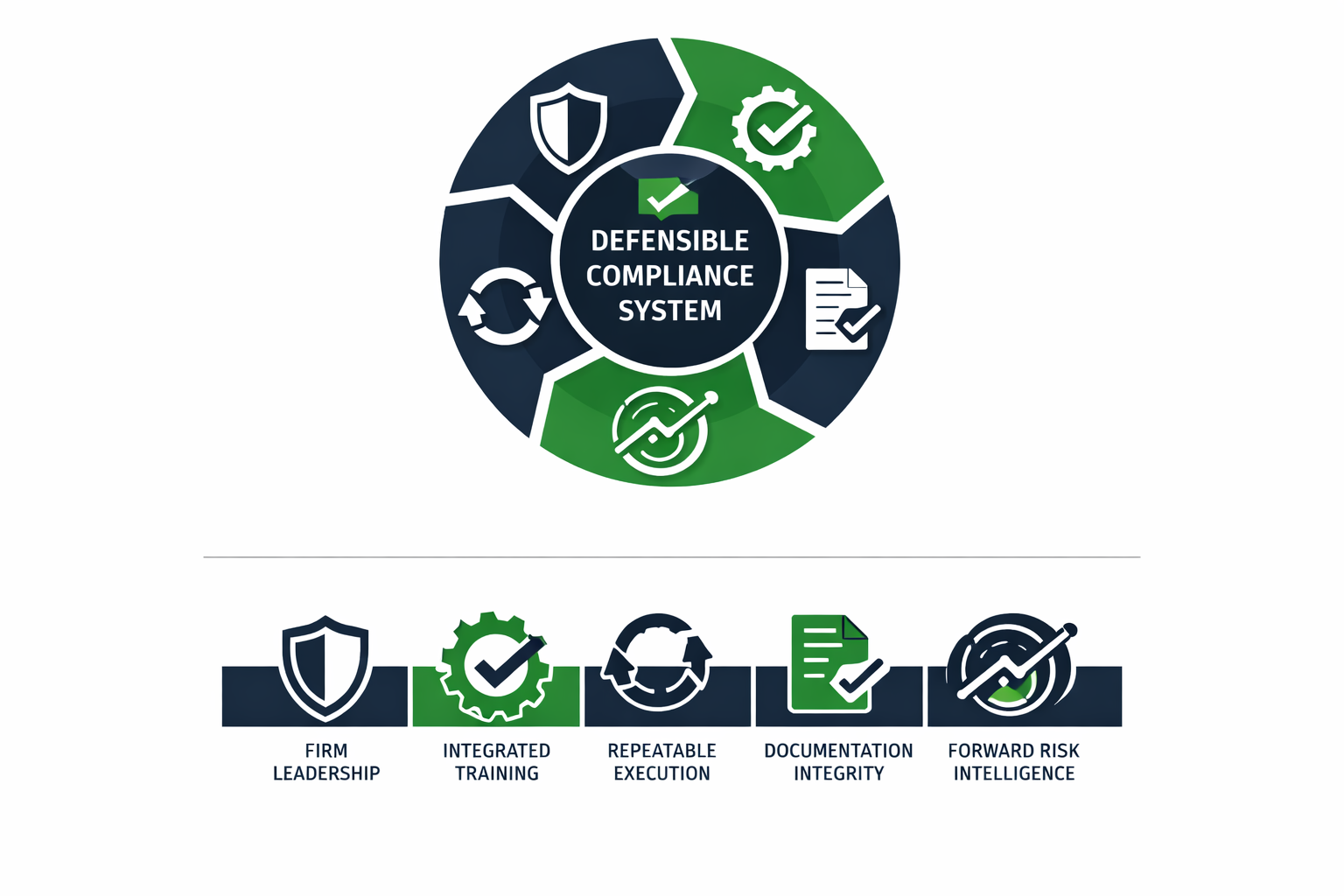
FFIRM-5 is NEXTGEN Driver Training & Compliance’s operating control framework for building defensible fleet compliance systems.
It defines the five integrated control domains that determine whether a fleet can withstand regulatory scrutiny, insurance evaluation, and post-incident investigation.
FFIRM-5 does not measure paperwork activity.
It measures operational integrity.
Weakness in any one control degrades the stability of the entire compliance system.
The Five Operating Controls
1. Firm Leadership & Governance
Where compliance accountability is established and enforced
Compliance performance begins with leadership ownership.
Roles, authority, escalation pathways, and decision accountability must be clearly defined and actively enforced.
When governance is weak:
- Standards drift
- Enforcement becomes inconsistent
- Decisions become person-dependent
- Regulatory exposure increases
Strong fleets establish:
- Named compliance ownership
- Clear authority boundaries
- Management review cadence
- Corrective action discipline
- Executive visibility into risk
2. Forward Risk Intelligence
Where emerging risks are identified before they become violations or losses
Reactive compliance waits for problems to occur.
Defensible compliance anticipates them.
Forward risk intelligence means continuously monitoring:
- Inspection trends
- CVOR performance
- Incident data
- Near-miss indicators
- Regulatory changes
- Insurance signals
This allows leadership to identify early warning signs and intervene before enforcement, claims, or losses escalate.
Fleets without risk intelligence operate blind.
3. Integrated Training & Competency
Where competency is verified, documented, and sustained
Training attendance does not equal competence.
Defensible fleets operate structured systems that verify:
- What training occurred
- How competency was evaluated
- Who authorized qualification
- How ongoing competence is maintained
- How evidence is retained
Competency must be provable — not assumed.
This protects:
- Operational safety
- Regulatory compliance
- Insurance defensibility
- Post-incident credibility
4. Repeatable Operational Discipline
Where safe performance becomes consistent, repeatable behavior
Policies only matter if they are executed consistently in the field.
Operational discipline governs:
- Pre-trip inspections
- Defect reporting and repair
- Dispatch compliance
- Hours-of-service integrity
- Supervisor enforcement
- Deviation correction
This is where most fleets quietly fail — not because they lack policies, but because discipline erodes under operational pressure.
Consistency protects outcomes.
5. Measurable Documentation Integrity
Where operational proof is accurate, complete, and defensible
If it is not documented correctly, it did not happen in the eyes of regulators, insurers, and courts.
Documentation must demonstrate:
- Traceability
- Accuracy
- Timeliness
- Version control
- Evidence retention
Records are not administrative burden — they are legal protection.
Why FIRM-5 Matters for CVOR, Insurance, and Liability
FIRM-5 directly impacts:
- CVOR performance and audit outcomes
- Insurance underwriting and premium stability
- Claim defensibility and litigation exposure
- Regulatory enforcement risk
- Operational reliability and reputation
Strong systems reduce volatility.
Weak systems create compounding risk
Assessing Your Compliance Defensibility
Most fleets cannot accurately evaluate their own compliance maturity.
NEXTGEN conducts structured Defensibility Assessments using the FFIRM-5 framework to identify:
- Control gaps
- Risk exposure
- Maturity level
- Stabilization priorities
This provides leadership with clarity — not assumptions.
👉 Book a Defensibility Assessment with NEXTGEN
Build compliance systems that hold up when scrutiny arrives.